
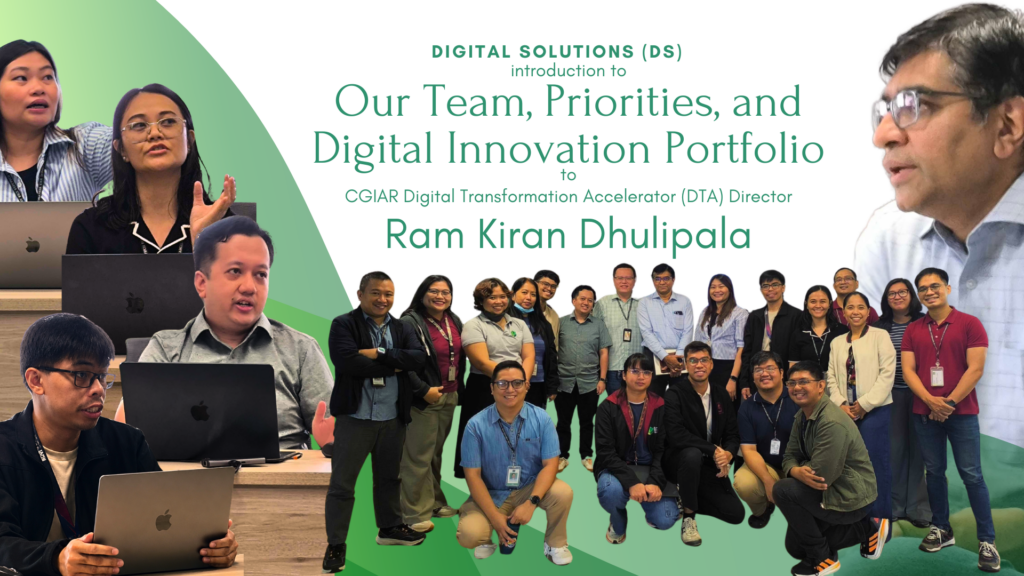
The Digital Solutions (DS) team based in the Philippines met with the CGIAR Director of Digital Transformation Accelerator (DTA), Ram Kiran Dhulipala, at IRRI Headquarters on 11 August 2026. The event showcased the team’s strategic priorities, organizational structure, and the expanding suite of digital solutions being designed to support CGIAR’s breeding and research efforts. Jack Lagare gave a presentation on DS’s people, priorities, and digital portfolio within the Breeding Resources Area of Work. He reflected on the team’s global structure and the collaboration of specialists in the three functional areas: Innovation Delivery (ID), Gestión de Relaciones Empresariales (BRM), and Capacitación en Soluciones (SE) from different CGIAR centers. Our goal is to design, develop, and support digital solutions that stimulate creativity and workflow solutions. Jack also stressed the team’s desire to build user-friendly, integrated solutions that enable researchers and breeding programs to make data-driven, well-informed decisions. The session included introductions from the leads of each functional area. They outlined the individual responsibilities, products, and contributions of their respective teams to the organization’s mission during the presentation.
Eugenia Tenorio introduced the Solutions Enablement (SE) team and summarized their work across these capabilities: Cloud Engineering Services and Support, Quality Engineering, EBS Database Management, Data Migration Pipelines, and other Cloud Solutions. She explained how the team provides solutions and supports customers, including developers and stakeholders, to help achieve the objectives of DS. She emphasized that these efforts are essential for ensuring the security, reliability, and scalability of the team’s products and tools.
Jahzeel Calosa gave a presentation about the Business Relationship Management (BRM) team and how the team bridges the gap between technology and its users thru adoption, global user support, training programs, and business analysis to ensure Digital Solutions meet stakeholder requirements. She also emphasized the team’s concrete contribution to key operational metrics like global adoption and user support performance.
One discussion that caught Ram’s eye right away was about the “Our Impact—By the Numbers” slide. The presentation highlighted that DS currently serves 24 countries, 10 institutes, 29 crops, and over 700 active users, with a Customer Satisfaction (CSAT) score of 4.9 of 5 and a Learner Satisfaction Rating (LSR) of 4.7 of 5, and nearly 24-hour user support coverage across the Latin America, Africa, and Asia. Ram asked about the platform the team uses to gather and assess customer satisfaction. Jahzeel replied that DS can continuously measure the customer experience and identify opportunities for continuous improvement using JIRA Service Management to collect user feedback and track service quality. It fills the team’s commitment to evidence-led service management and user-centered delivery.
Argem Flores then introduced the Innovation Delivery (ID) team and its role in software development, database engineering, quality engineering and interoperability. He explained how the team is continuously developing and improving the Enterprise Breeding System and how EBS allows for easy integration with other digital platforms within CGIAR.
Jack then provided an overview of the DS’s strategic direction, including the organization’s goal to scale and operationalize the Breeding for Tomorrow (B4T) Enterprise Data Ecosystem by 2027, with the Enterprise Breeding System playing a significant role. The roadmap aimed to expand interoperability, strengthen governance and boost the uptake of integrated digital solutions across CGIAR breeding programs.
The technical discussion was particularly interesting when Jack presented the Current State Diagnostic architecture diagram, illustrating the current DS technology landscape, and the different levels of integration between systems supporting breeding operations. Ram was very interested in understanding how the different applications interact with the Enterprise Breeding System, especially the interaction between the Breeding Portal and EBS.
Argem added that the Innovation Delivery team develops the Application Programming Interfaces (APIs) that allow the Breeding Portal to talk directly to the EBS. These APIs facilitate secure and efficient exchange of data between EBS and connected applications, enabling information to flow seamlessly across the digital ecosystem and supporting integration between breeding tools and services. The importance of APIs to facilitate an integrated breeding platform and to reduce dependency on manual data transfer was emphasized.
Ram was also very interested in the “Multiple Breeding and Non-Breeding Projects” slide, which sparked further discussion on DS’s growing portfolio beyond the Enterprise Breeding System. In the presentation, Jack touched on a couple of points that illustrated how DS’s larger mission is to build interoperable digital products that extend beyond breeding data management. The discussion focused on the integration of GGCE with EBS for unified germplasm reporting and traceability, providing standard reporting for CGIAR breeding programs. Jack also addressed how projects like OFVT and other digital products and services demonstrate the team’s dedication to employing its technical strengths across a broader spectrum of breeding, genebank and research projects, while building a linked digital ecosystem that serves a range of scientific and operational requirements.
Throughout the session, Ram engaged actively with the presenters, asking insightful questions related to what DS does, how its impact is measured, how its technologies work together, and other related topics that help CGIAR to achieve long-term digital transformation goals. Discussions revealed a common interest in building scalable, integrated, user-driven digital solutions to foster research collaboration across the CGIAR network.
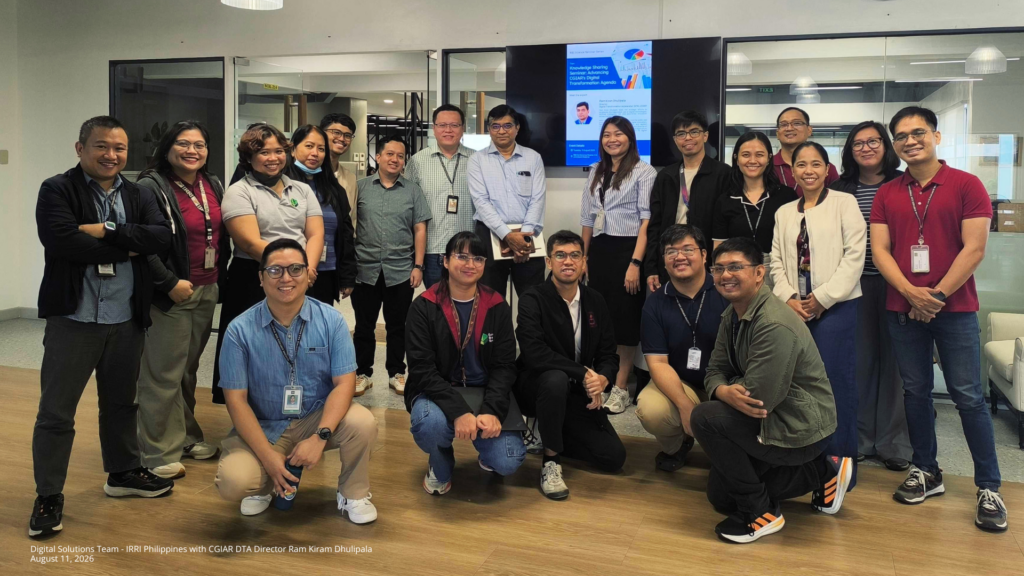
The meeting ended with an open discussion where the DS team showed its commitment to deliver innovative, interoperable, and sustainable solutions that empower researchers, accelerate breeding innovation, and advance CGIAR’s mission to transform food, land, and water systems for a food-secure future through the sharing of its organizational vision, technical capabilities, measurable impact, and growing portfolio of digital products.