



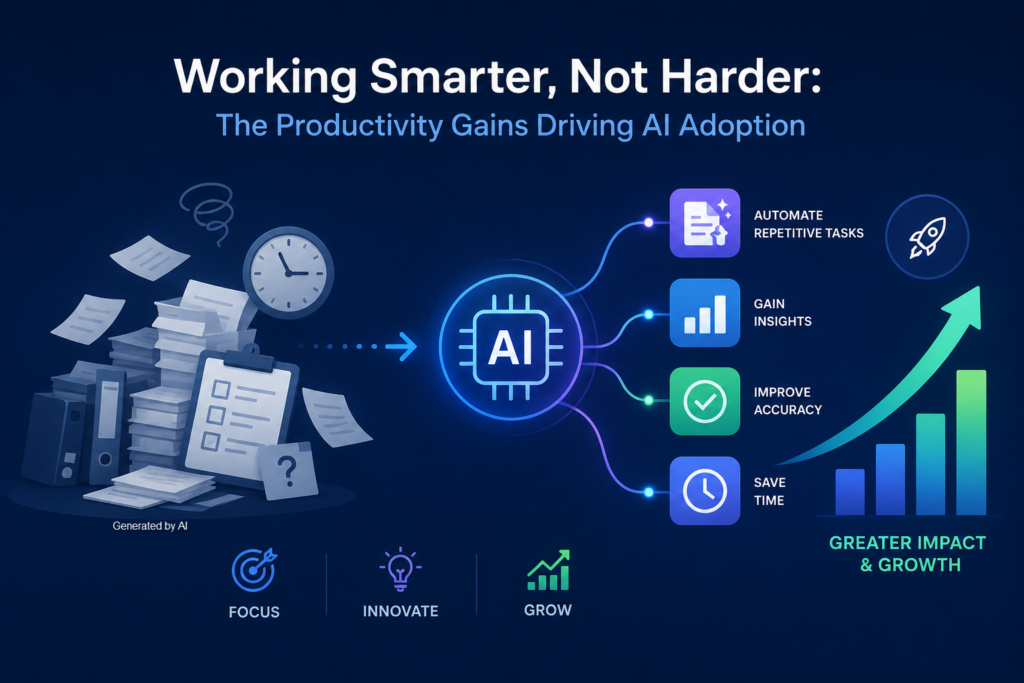
Artificial intelligence (AI) adoption is increasingly influencing the way the Digital Solutions (DS) team operates, collaborates, and brings value. What started as individual exploration is becoming a practical capability to assist personnel in working more efficiently, to enhance quality, and to concentrate on higher-value tasks.
The survey showed that 80% of respondents utilized AI daily, while the rest opted for it occasionally. Team members use AI to help them with software development, cloud operations, documentation, planning, communications, and workflow automation — one more example of how AI has become increasingly ingrained into everyday business processes.
Accelerating Software Development
Software engineering has become one of the areas where AI is widely utilized. Based on the survey, AI-powered code writing, code review, refactoring, and debugging tools available in open-source and on commercial platforms are also being used by team members to create unit tests for more secure software, remediate vulnerabilities faster, and add improvements to APIs with technical documentation.
Many developers acknowledge that AI speeds up the development process by providing suggestions on code skeletons, user interface elements, and unit tests. Others mentioned its role in clarifying some unfamiliar patterns in coding or helping in the transition period between different programming languages has significantly optimized and accelerated research and software development work.
Operations and Technical Support Enhancements
AI also assists in cloud engineering and operations. Survey results reveal that AI has been used to help configure cloud services, identify and resolve infrastructure problems, streamline standardized workflows and help with proof-of-concept implementations.
Previously, some of our customers experienced printout issues, and by using the aid of AI-driven insights, we promptly found the root cause: some of the templates were being flagged by our web application firewall (WAF) because they presented potential security risks. To minimize disruption, we activated temporary, secure guardrails immediately to resume printing while mapping out the exact application updates necessary to achieve a permanent fix.
Improving Documentation and Communication
AI is significantly transforming the software industry but how knowledge is created and distributed. Team members also utilize AI to put together end-user documentation, update user guide video scripts, write reports, summarize meetings, polish messages, organize, and synthesize information from different resources. Others point out that AI takes ideas and loose concepts, and converts them into content that is structured for each audience, speeding up documentation. Atlassian Intelligence and Rovo help teams navigate document repositories, discover critical knowledge, and accelerate information discovery within the Atlassian suite.
Enhancing Planning and Learning
AI is helping teams plan projects, research, and learn with greater efficiency.
Survey respondents said they have been using tools such as Google Gemini, Rovo, and Kiro to investigate CI/CD workflows, unfamiliar technologies, system interactions, to draft implementation plans, and to compartmentalize projects by manageable tasks.
“We use AI to create a bird’s eye view map of the Breeding for Tomorrow ecosystem, allowing us to see relationships across systems without needing to be an expert on every single integration,” said one.
A Diverse AI Toolkit
The survey identified a diverse ecosystem of AI tools supporting different workflows across the team. Some of the best-known ones are ChatGPT, Google Gemini, Microsoft Copilot, Claude, Kiro, Atlassian Intelligence, Rovo, Canva AI, and Grammarly. These tools are being utilized in areas such as software engineering, cloud operations, project planning, content creation, design, knowledge management, communications, and user support.
AI is also creating opportunities to enhance service and scale support, in addition to contributing to individual staff productivity. For example, the DS team has been exploring the use of AI in the DS Support Desk to automate routine ticket management to offer more efficient replies to common questions. By reducing the time spent on operational support activities, the team will free up additional time to onboard and support other services such as Bioflow. For our users, this means a double benefit: faster responses to general questions and requests, and more access to quality support services across CGIAR.
Looking Ahead
The respondents being polled mentioned better productivity, better quality of work, and substantial time savings in the use of AI. They also underlined the need to embrace these benefits responsibly to take advantage of them in a sustainable way. Clear guidance, knowledge sharing, collaboration, and continuous learning were consistently identified as key enablers for long-term success across all of the survey outcomes.
The DS team has learned that being AI-ready is much more than just adopting new tools. This means leadership commitment, workforce capability, collaboration, and a culture that encourages innovation and continuous learning. As AI continues to be progressively more embedded in our routine ways of getting things done, there is an opportunity for organizations to explore new ways to improve productivity, improve service delivery, and find innovative solutions to complex challenges.
The development of AI governance frameworks that address data privacy, security, ethical use, and quality assurance, so that staff can use AI with confidence and accountability, is one of the next steps in this journey. By clearly defining policies and best practices, organizations can leverage the benefits of AI while ensuring its responsible and sustainable use.