


The adoption of the Enterprise Breeding System (EBS) by IITA’s yam breeding program marks an important step in the transition to a multicrop EBS instance supporting breeding programs across RTB crops. The transition from YamBase to EBS brings breeding data and workflows onto a shared platform, creating a foundation for more integrated data management and collaboration across IITA breeding programs.
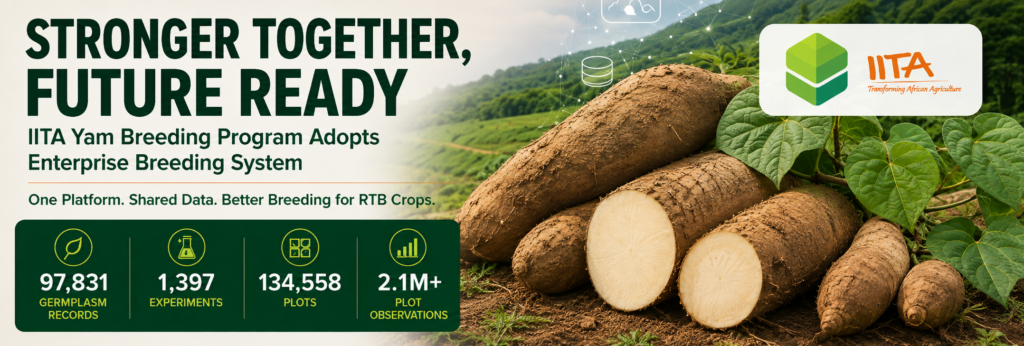
The scale of the yam transition is reflected in the data now managed in EBS: 97,831 germplasm records, 1,397 experiments, 134,558 plots, and over 2.1 million plot observations successfully migrated into the EBS production environment.
The transition is also a team effort involving breeders, data managers, leadership, national partners, and Digital Solutions teams. It was driven by a cross-functional team comprising Andre Moretto Embersics, DS Lead; Marko Karkkainen, Project Lead; and May Ann Sallan, Data Migration Lead. IITA yam breeder and data managers Paterne Agre and Simon Imoro also played key roles in preparing and migrating the breeding data into EBS.
Adoption activities began in February 2026, and production data migration was completed on June 10, 2026. The IITA Cassava and Yam EBS Kick-off Meeting held on July 8 brought together IITA leadership and breeding teams, national program partners, and the Digital Solutions/EBS team to discuss progress and agree on the next phase. IITA leadership, including Hapson Mushoriwa, Ismail Rabbi, and Asrat Amele, along with national program partners from NRCRI, TARI, NARO and CNRA, reaffirmed EBS as a common breeding data platform for RTB crops.
Transitioning from YamBase to EBS
The adoption journey began with an assessment of existing YamBase data and workflows. The team then developed a migration plan, prepared the agreed data for transfer, established the new Multicrop EBS production environment, and added the required Yam configurations.
Another important activity was the implementation of a series of train-the-trainer capacity-building sessions to strengthen IITA’s internal capacity and establish a stronger support base for the wider adoption and sustained use of EBS across the institute.

Lastly, a biweekly meeting was also held as a project checkpoint. It brought together the progress made in understanding YamBase, migrating the data, establishing the EBS environment, and preparing users for adoption. It also reinforced stakeholder commitment to more consistent data management and collaboration across RTB breeding programs.
What It Means for Stakeholders
For IITA leadership, the adoption represents a step toward consolidating breeding data into a common platform, supporting more integrated and efficient breeding operations.
For yam breeders and data managers, EBS now supports foundational workflows including germplasm management, inventory, experiments, and phenotypic data collection. Continued guidance will be important as remaining workflows are finalized.
For national program partners (including NRCRI, TARI, NARO, and CNRA), the operationalization of EBS creates a foundation for more standardized data structures, reporting, and collaboration across programs. The next opportunity is to extend the value of the platform through continued end-user training and adoption within partner teams.
For the DS/EBS team, the adoption provides an important learning opportunity. The experience highlights both the potential of a shared platform and the need to anticipate crop-specific workflow requirements when preparing future adoption projects.
What Remains
Now that the yam migration and Train-the-Trainer activities are done, the immediate focus is on driving adoption and completing remaining priority workflows. The Harvest Manager configuration requires further exploration, while work continues on polycross, open pollination, and aspects of bi-parental, family, and crossing nomenclature.
At the same time, IITA’s cassava breeding program is the next focus for EBS adoption. The next phase will focus on preparing and migrating cassava data, establishing the required EBS environment, and preparing the cassava team to begin using the platform.
This provides a clear path for scaling the transition from yam to cassava and strengthening the use of EBS across IITA breeding programs.
Looking Ahead
The successful Yam adoption establishes the first important foundation for IITA’s multicrop EBS environment. The next phase will focus on completing remaining yam priorities, supporting sustained user adoption, and advancing the Cassava transition.
The broader goal is not simply to move individual crop datasets into EBS, but to create a connected and sustainable breeding data environment across RTB crops. By building from Yam and extending to Cassava and other programs, IITA can strengthen data integration, collaboration, and access to information needed to support more informed, data-driven breeding decisions.