



Following the insights shared in “Building an AI-Ready Organization: Lessons from Our Team’s Adoption Journey“, where the Digital Solutions team highlighted how successful AI adoption depends on continuous learning, collaboration, and practical application, the next step was to equip technical teams with the skills to confidently apply these principles in their daily work. Building an AI-ready organization extends beyond adopting AI tools—it requires empowering developers with structured approaches that improve software quality, encourage collaboration, and support responsible AI-assisted development.
A practical virtual learning session demonstrated how Kiro IDE and CLI can support structured software development, enhance collaboration, and reduce technical debt through AI-assisted workflows.
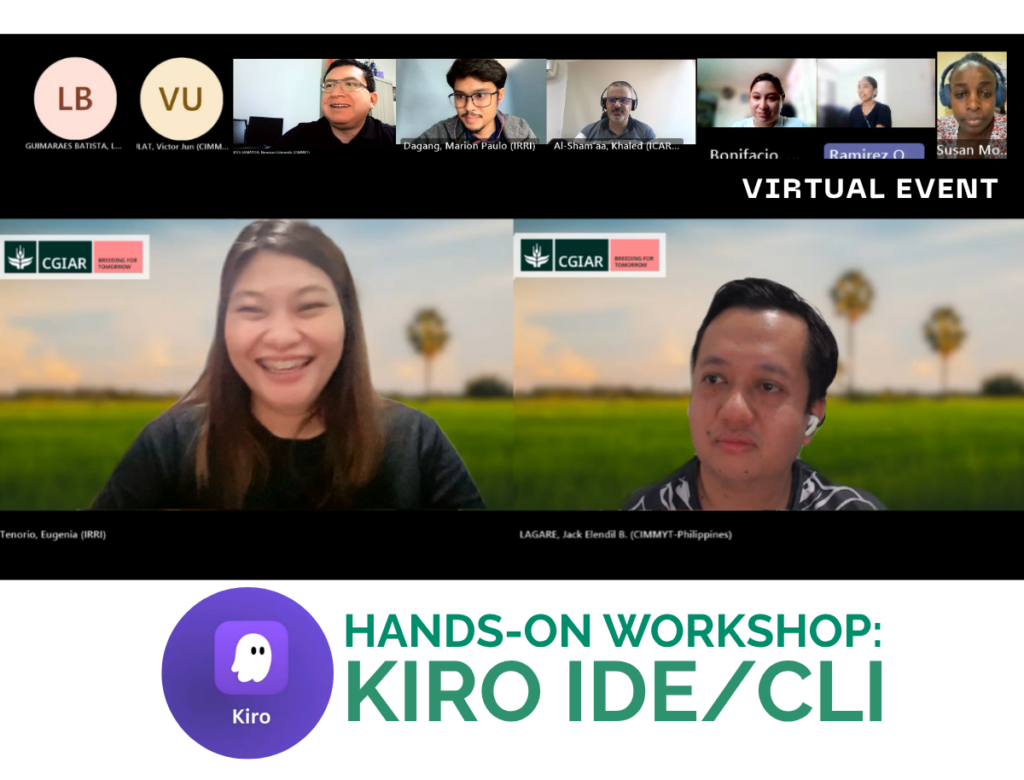
Selected attendees from IRRI, CIMMYT, ICARDA, ICRISAT, and other CGIAR initiatives participated in the Virtual Hands-on Workshop on Kiro IDE and CLI to explore how AI-assisted development can be integrated into software engineering workflows. Held on June 11, 2026, the two-session workshop was led by Eugenia Tenorio (IRRI) with support from Jack Lagare (CIMMYT). Through live virtual demonstrations, collaborative discussions, and practical exercises, participants gained hands-on experience applying Kiro to their own customized projects while exploring structured AI workflows that promote more efficient, maintainable, and high-quality software development.
Introducing Kiro’s Structured Development Workflow
The workshop began with an overview of Kiro, AWS’s AI-powered development environment that extends beyond traditional code completion to support structured software development. Participants explored the differences between Vibe Coding for rapid prototyping and Spec-Driven Development, a workflow that guides developers through generating and reviewing requirements, system designs, and implementation tasks before writing code.
The session also introduced advanced Kiro features, including Agent Hooks, Agent Steering, and the Model Context Protocol (MCP), which help automate documentation, maintain coding standards, and integrate external tools into development workflows.
Practical Insights from the Discussion
The interactive conversation was about how to manage AI productivity with efficient credit use.
Participants expressed practical recommendations on how to optimize AI costs without compromising the quality of development. Victor Jun Ulat (CIMMYT) suggested that requirements should be drafted with other AI tools before they are implemented in Kiro. Lorena Guimaraes Batista (CIMMYT) pointed out that a thorough review of requirements and designs before implementation substantially reduces debugging efforts and unnecessary consumption of AI credits.
Building on this, Jack Lagare (CIMMYT) pointed out that while Spec-Driven Development could need more preparation initially, it saves technical debt and avoids costly changes at a later stage in the development process.
Hands-On Learning Through Real Use Cases
Following the demonstrations, participants applied Kiro to their own projects during a guided hands-on session, using the platform to prototype new applications, enhance existing solutions, and explore practical development scenarios. Facilitators provided real-time support while encouraging participants to experiment with Kiro’s structured workflow.
The workshop concluded with participant showcases their personal use cases that demonstrated Kiro’s application across diverse projects:
Newman Montes Samayoa (CIMMYT) used Kiro to assess and improve the design of an existing NiFi integration project, generating recommendations for infrastructure optimization.
Lorena Guimaraes Batista (CIMMYT) demonstrated enhancements to a BioFlow module, illustrating how Kiro speeds up UI creation while reinforcing the importance of reviewing and refining AI-generated outputs.
Khaled Al-Sham’aa (ICARDA) presented a Shiny-based wizard that simplified database selection workflows, highlighting how Spec-Driven Development supports more structured and maintainable solutions.
Victor Jun Ulat (CIMMYT) developed a Python and Flask-based coffee brewing ratio calculator, demonstrating how Kiro can rapidly transform real-life ideas into functional applications while supporting efficient and structured AI-assisted development.
Key Takeaways
The workshop emphasized that successful AI-assisted programming is more than code creation. Participants showed how Kiro can improve software quality, reduce technical debt, and enable more efficient development techniques through the use of structured planning, collaborative review, and iterative refinement. The workshop also stressed the need to pick the best AI methodology for each project and to put developers at the heart of design, validation, and decision-making.